

Julian Thorne
Crypto analyst and guide author. Making complex technologies clear for everyone.
How to Set a Stop-Loss in Crypto Trading?
Cryptocurrency is not just a hobby for enthusiasts but a fully fledged financial market, home to huge investment funds and complex computer programs. However, one rule remains unchanged: crypto prices can fall just as quickly as they rise. Experienced investors think not only about making money but also about how to avoid losing it by hedging risks. The key tool in this matter is a stop-loss order.
How Do Stop-Loss Orders Work?
In simple terms, a stop-loss order is a special command you give to the exchange: "If the price of my coin drops to a certain level, sell it immediately so I don't lose more money". It's an automatic order that will execute without your intervention. Essentially, it's a pre-set limit on the losses you're willing to tolerate in a single trade.
The mechanism behind a stop-loss order is quite simple. In the trading terminal, your stop-loss order is a "dormant" order. It's invisible to other market participants and doesn't affect the price until it touches the level you set. At that point, the sensor is triggered, and your sell order is sent to the general order queue.

Types of Stop-Loss Orders
It is important to understand that the exchange can execute your order in two main ways: market and limit.
A market stop-loss operates on the principle of "sell at any price, as long as it's fast". As soon as the coin price touches your threshold, the exchange sells your asset to the first available buyer. This ensures that you exit the trade and don't end up with devalued coins. However, there's a catch called "slippage". If the market falls very quickly, the price may fall past your level so quickly that the exchange will only sell the asset at a price slightly lower than you planned.
A limit stop-loss is a more cautious option. Here, you specify two prices: the activation price (when the exchange is ready to wake up) and the strike price (below which you won't sell). This gives you control over your money but creates risk: if the price falls rapidly, it could simply pass your limit price, and your order will remain unfilled while the coin continues to depreciate.
How to Set a Stop-Loss Order?
Setting a stop-loss order on modern exchanges has become incredibly simple. Even mobile apps allow you to do it in a couple of clicks. The smartest solution is to set a stop-loss order immediately when you buy cryptocurrency.
We'll demonstrate how this works using Cryptomus as an example.
When you open a trading terminal on an exchange, you'll see a section often labelled TP/SL (Take Profit and Stop Loss).
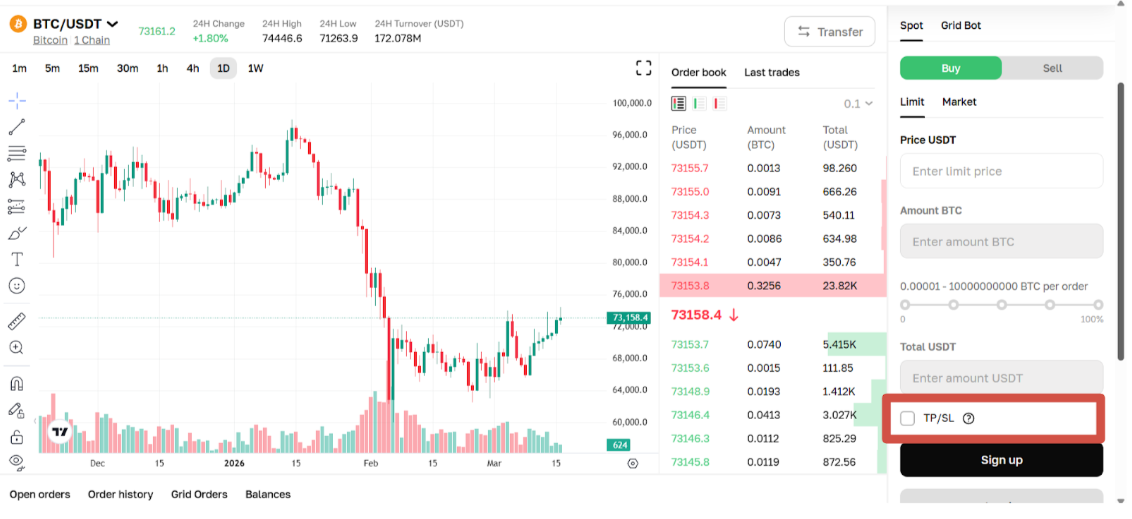
A Take Profit is an order to sell at a profit, while a Stop Loss is an order to limit your losses. To set them up, you enter numbers in the corresponding fields. These are the points at which you want to exit the trade.
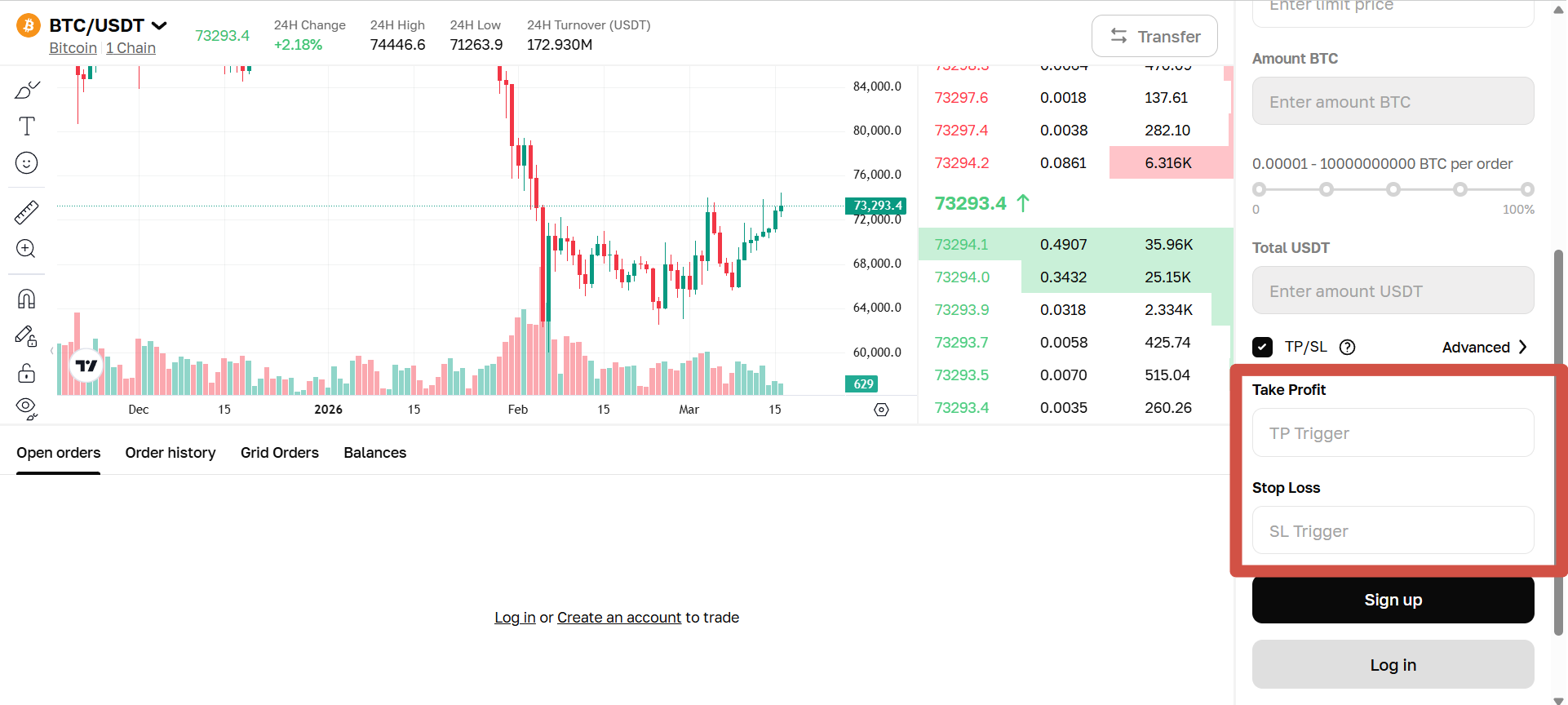
Let's say you bought Bitcoin at $73,000. To limit your potential loss, you set a Stop Loss at $70,000. This means that if the Bitcoin price starts to fall and reaches that level, the exchange will automatically sell your asset. You can also set a Take Profit at the same time, for example, at $76,000. In the TP/SL section, you simply enter two numbers: $76,000 in the Take Profit field and $70,000 in the Stop Loss field. This way, your trade will work automatically: if the market rises, you lock in your profit, and if it declines, your loss will be limited to the preset level.
How to Use Stop-Loss in Trading?
Using a stop loss isn't just a matter of clicking a button; it's a complete strategy for managing your money.
How do you know where to place a stop loss? You need to consider the logic of price movement. Here are a few proven methods:
1. First, use support levels. Look at the chart: there are often prices below which the asset hasn't fallen recently. If the price breaks through such a level, it's a bad sign—it means the decline may continue. It's logical to place a stop loss just below this line.
2. Second, take volatility into account. Cryptocurrencies can have low (BTC, ETH, TRX), medium (SOL, XMR, AVAX, LINK), or high (low-cap coins) volatility. If a coin jumps 5-10% every day without any reason, then setting a short stop of 2% is pointless—it will be knocked out by a random fluctuation. There's a special indicator called ATR (Average True Range) — a tool for measuring market volatility, showing how much the price fluctuates over a given period. Experienced traders place their stops at twice the current ATR. This gives the price room to breathe but protects against a full-blown collapse.
3. Third, evaluate the mathematical risk-reward ratio. The golden rule of trading is that your potential profit should be at least two to three times your potential loss. If your stop-loss is 5% below your purchase price, your target should be at least 10-15% higher. If you follow this rule, even if half of your trades are unprofitable, you'll still be profitable by the end of the month.
Another useful technique is moving the trade to breakeven. When the price of your coin has already risen significantly, and you're in good profit, you can move your stop-loss to the price at which you bought the asset. Now, no matter what happens in the market, you're guaranteed not to lose money on this trade. This is a great way to relieve psychological stress and trade with peace of mind.
 Start trading affordable cryptocurrencies todayAccess low-priced cryptocurrencies, real-time charts, and fast order execution on Cryptomus. Trade trending coins with a user-friendly platform.
Common Mistakes to Avoid
There are a number of mistakes when setting stop-loss orders that can lead to failure.
The first mistake is the psychological trap of "stop-trailing". It happens like this: the price approaches your stop-loss, you become afraid to take a loss, and so you move it a little lower, hoping that the price will reverse. Then even lower. Instead of a small, manageable loss, you end up with a huge hole in your budget. A stop-loss is a promise you make to yourself, and you can't break it.
The second mistake is using stop-losses that are too short or too tight. If you place a stop-loss too close to the current price, it can be triggered by random market noise or a small fluctuation. As a result, you'll find yourself out of the trade just before the price moves higher. To avoid this, always consider current market volatility and don't try to skimp on every penny.
The third mistake is ignoring liquidity. There are many new, small coins on the market. If you trade such assets in large amounts, your stop-loss order may perform very poorly simply because there won't be enough buyers willing to take your volume when the market dips. In such markets, you need to be especially cautious and use smaller amounts for your trades.
The fourth mistake is "revenge trading" after a stop-loss is triggered. When your stop-loss is triggered, it often leads to anger or resentment towards the market. The trader wants to immediately "get their money back" and opens a new trade, often with an even larger size and without any plan. This is a surefire way to ruin. A stop-loss is not a personal insult but a normal part of the trade. The best thing to do in such a situation is to calm down and return to market analysis with a fresh mind.
Remember, a stop-loss is your insurance. In crypto trading, a stop-loss is the only thing that guarantees your ability to continue after any incident. Discipline and the ability to accept small losses are what separates a successful investor from those who lose everything in the first month.
We hope this article helped you understand stop-loss orders. If you still have questions, feel free to ask them in the comments!


