

David McMillan
Crypto-enthusiast who explores all the possibilities the blockchain technology suggests
What is the Diamond Pattern and How to Use It in Trading
There are many different patterns in the crypto world that help traders to make successful deals. In this article, we'll explore a diamond pattern: what it is, what it looks like, and how to use it in trading. Let’s begin!
What is a Diamond Pattern?
The diamond pattern is a rare graphic figure of a trend reversal formed through a sequence of expanding highs and lows, followed by their compression, creating a diamond shape. It can be either bullish or bearish: a bullish diamond appears at the end of a downtrend and signals a possible rise, while a bearish diamond forms at the top of an uptrend and warns of a likely decline.
Bearish Diamond Pattern
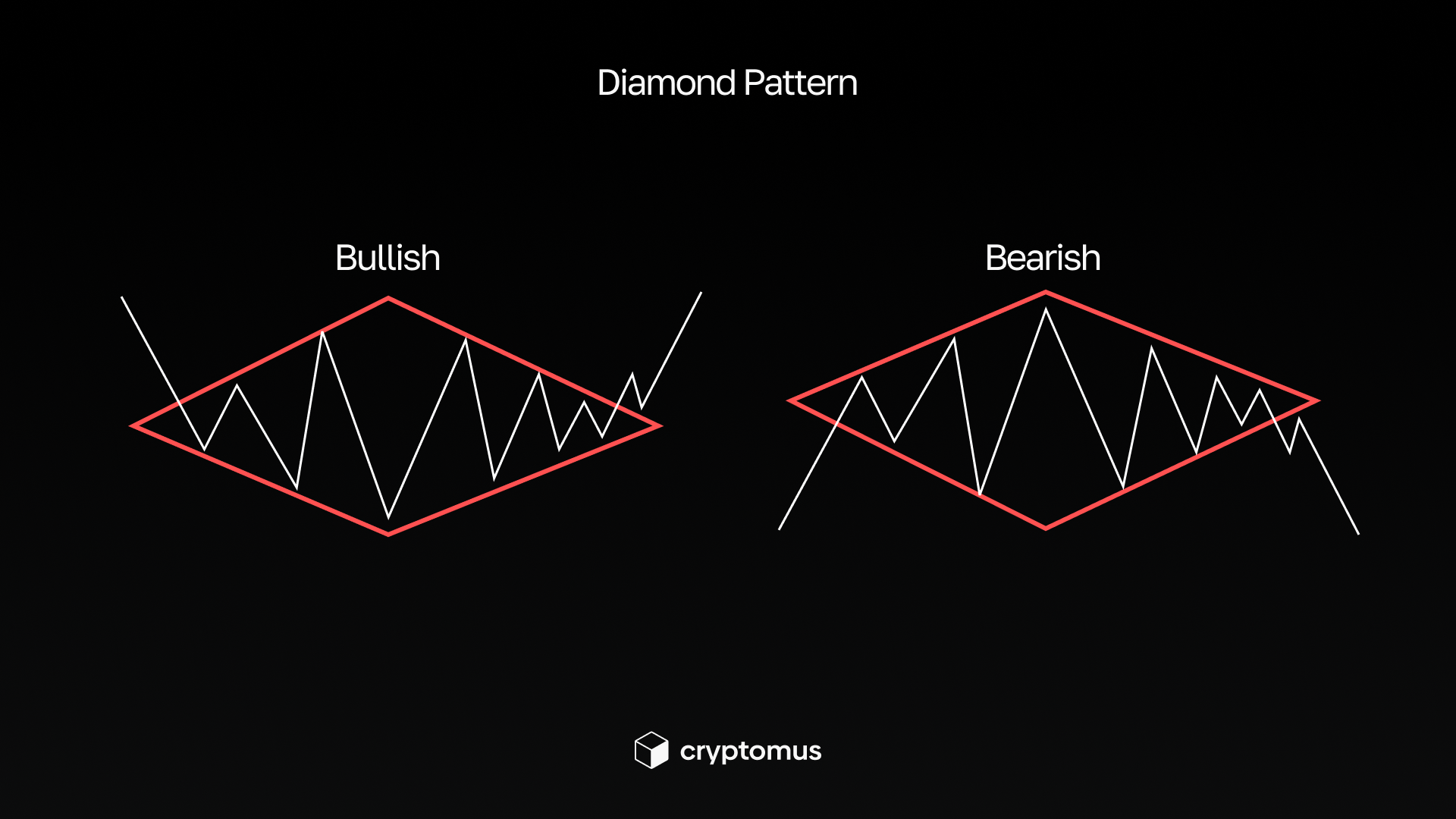
The bearish version of the diamond pattern forms at the top of an uptrend and indicates a gradual exhaustion of buying power. Firstly, the price creates higher highs and lower lows—the market “expands”, and volatility and a struggle between the sides grow. Then the structure begins to “contract”: the highs become lower and the lows higher, indicating a dampening of momentum and preparation for a reversal. Price breaking through the lower border of the diamond indicates a probability of a transition to a downtrend.
To be sure that the diamond pattern is reliable, you need to accompany it with confirmation: an increase in volume at the breakout, weakness on higher timeframes, and bearish candlestick patterns within the structure. A bearish diamond often results in a sharp decline, so traders use it as an opportunity to enter a short position immediately after a confident downward breakout.
Bullish Diamond Pattern
The bullish version of the diamond pattern forms at the bottom of a downtrend and signals a possible upward reversal. At the beginning of the movement, the price expands—lower lows and higher highs,—this is about increased volatility and a struggle for control. Then the structure begins to contract: highs become lower and lows become higher; this means that sellers are losing strength and the market is stabilizing. The key moment is the breakout of the upper border of the diamond—this is the main bullish signal that indicates a transition of the price to a new upward momentum.
The reliability of a bullish diamond also increases with confirmations: an increase in volume at the breakout, bullish candlestick patterns, and support from higher timeframes. Most often, after a confident upward breakout, the price forms a strong upward movement, which makes the bullish diamond a convenient pattern for entering a long position.
How to Identify This Pattern?
The diamond pattern can be identified by its characteristic sequence of [expansion → contraction] of the price. First, the price forms an expanding range of higher highs and lower lows—the chart literally “spreads out to the sides”. Then the market moves into a contraction phase: the highs become lower and the lows higher, and the range gradually narrows, forming a diamond. To accurately identify the pattern, the trader connects the extremes with trend lines, obtaining intersecting channels—one expanding, the other narrowing. Confirmation comes from the fact that the pattern occurs after a strong trend and ends with a breakout of one of the edges—upward for the bullish variant and downward for the bearish one as shown on the picture below.

How to Use the Diamond Pattern in Trading?
The diamond pattern is used by traders as a sign of potential opportunity to gain off price movements. Below are the key ways to apply the pattern in real trading.
-
Indicating the right time for entering. While the price is inside the diamond, it’s too early to take a trade: the structure only reflects uncertainty. Enter only after a strong candle closes above the top (bullish) or below the bottom (bearish). The breakout is the real signal.
-
Confirming the opportunity. Since the “diamond” often produces false breakouts, you must check the breakout’s quality. Higher volume, alignment with the higher-timeframe trend, reversal candles, or confirmations from indicators like RSI or MACD all strengthen the signal.
-
Placing a stop loss. Set the stop loss after the breakout candle closes and the pattern gives a clear direction. In a bullish breakout, the stop is usually placed below the opposite side of the diamond or slightly below the last swing low inside the pattern. In a bearish breakout, the stop goes above the opposite side or slightly above the last swing high.
-
Determining price movement targets. Calculate how far the price may move after the breakout by using the “height rule”: measure the vertical distance between the highest and lowest points of the diamond and project that distance from the breakout point. This gives a primary price target.
-
Retesting the boundary. A conservative strategy is to wait for a retest of the pattern’s boundary after the breakout. This can give a better entry and a tighter stop loss.
 Start trading crypto easilyMake your first order on Cryptomus with high liquidity, an intuitive interface, and advanced trading tools.
Pros and Cons of Diamond Pattern
For you to understand the pattern even better, we've created a table describing the most vital advantages and disadvantages of it.
| Aspect | Characteristics | |
|---|---|---|
| Pros | 1. Makes it easier to catch major trend swings after the breakout. 2. The clear geometry of the structure makes it visually recognizable to traders. 3. Universal analysis tool: works in different markets and timeframes. 4. Allows you to accurately calculate targets and set a clear target plan based on the height of the pattern. 5. Combines well with volumes and higher timeframes, increasing the reliability of signals. | |
| Cons | 1. Occurs quite rarely, so it is difficult to use regularly for practice. 2. Hard to mark consistently: traders often draw the diamond differently, which leads to unclear signals. 3. Often accompanied by false breakouts, especially at low volumes. 4. Does not always reach the target height due to market volatility and external factors. 5. Does not work well in sideways and chaotic markets, where the structure is easily distorted. |
Have you ever encountered a diamond pattern? Did you use it? How did it go? Share your experience below!


