

Julian Thorne
Crypto analyst and guide author. Making complex technologies clear for everyone.
What are Stop-Loss and Take-Profit Orders
The crypto market is fast-paced and unpredictable: coin prices can soar and fall by tens of percent in a matter of hours. For the average person who doesn't want to spend 24 hours a day in front of a computer, special tools have been invented: stop-loss and take-profit.
These tools transform trading from a game of chance into a conscious process of financial management. Let’s look in more detail at what they are and how to use them.
Understanding Stop-Loss (SL) Orders
A stop-loss order is your "stop valve" used in crypto trading. Its primary and only purpose is to limit your losses. You tell the system in advance: "If the price drops to this level, sell my asset so I don't lose everything".
How does it work? As soon as the market price touches the level you set, the exchange immediately triggers your sell order. There are two types of TP orders: market and limit.
- Market order. Your position is closed immediately at any available price. This ensures you exit the trade, but in moments of panic, the price may be slightly worse than you planned.
- Limit order. You specify not only the trigger price but also the minimum price at which you are willing to sell. This gives you more control, but there is a risk: if the price falls too quickly, your order may simply be overrun, leaving you with a losing trade.
To prevent stop-loss orders from being triggered by random price fluctuations, traders use the ATR (Average True Range) volatility indicator. It shows how much the price typically "jumps" up and down. It's available on most exchanges in the technical indicators section, and is displayed as a curve showing the average price movement over a specified period.
Understanding Take Profit (TP) Orders
If a stop-loss protects you from fear, a take-profit protects you from greed. It's an order used in crypto trading to the exchange to lock in your profit. You tell the system in advance: "If the price rises to this level, sell it so I can take my profit".
It seems strange—why limit your profit if the price can rise indefinitely? But in the crypto market, anything that rises quickly can fall even faster. Take-profit orders are needed to transform your earnings from "numbers on a screen" into actual currency on your balance.
Traders often use a "ladder" approach—they don't close the entire trade at once but set several take-profit orders at different levels. For example:
- Sell 30% of an asset when the price has risen by 5% (to be sure of profit).
- Sell another 30% when the price has risen by 10%.
- Leave the rest to chance if a very strong rise occurs.
This is a great strategy for beginners: you've already pocketed some of your profits, you're psychologically at ease, and you can afford to watch the market move forward.
Key Differences Between Stop-Loss and Take Profit
While both tools help you manage your trade, they function as both "defense" and "offense." A stop loss is always aimed at preserving your position; it's triggered when things go wrong. A take profit, on the other hand, is triggered when everything goes according to plan.
The main technical difference is where they are placed relative to the price. If you bought an asset hoping for growth:
- A stop loss will always be below the purchase price.
- A take profit will always be above the purchase price.
How to Use These Orders in Trading?
To use these tools effectively, you need to understand where to set the levels. The easiest way is to look at support and resistance levels on the chart. Support is a level below which buyers typically refuse to allow the price to go. It's logical to place a stop-loss order just below this level. Resistance is the ceiling where sellers begin selling aggressively. It's best to place a take-profit order just short of this ceiling to ensure your trade is closed.
Let's imagine a real-life situation. You decide to buy 1 Bitcoin when it's trading at $70,000. You believe it will rise, but you understand that the market could move against you.
-
To avoid going broke in the event of a sudden crash, you set a stop-loss order at $67,000. If the price drops to this level, the exchange will sell your Bitcoin. You'll lose $3,000, but you'll save the rest of your money if the price drops even lower.
-
To avoid missing out on a winning opportunity, you set a take-profit order at $75,000. As soon as the price touches this level, the exchange will lock in your profit of $5,000. Even if the price of Bitcoin crashes a minute later, your money will already be safe in your account.
How to Technically Place These Orders?
Let's look at the Cryptomus exchange as an example.
-
Sign up with Cryptomus.
-
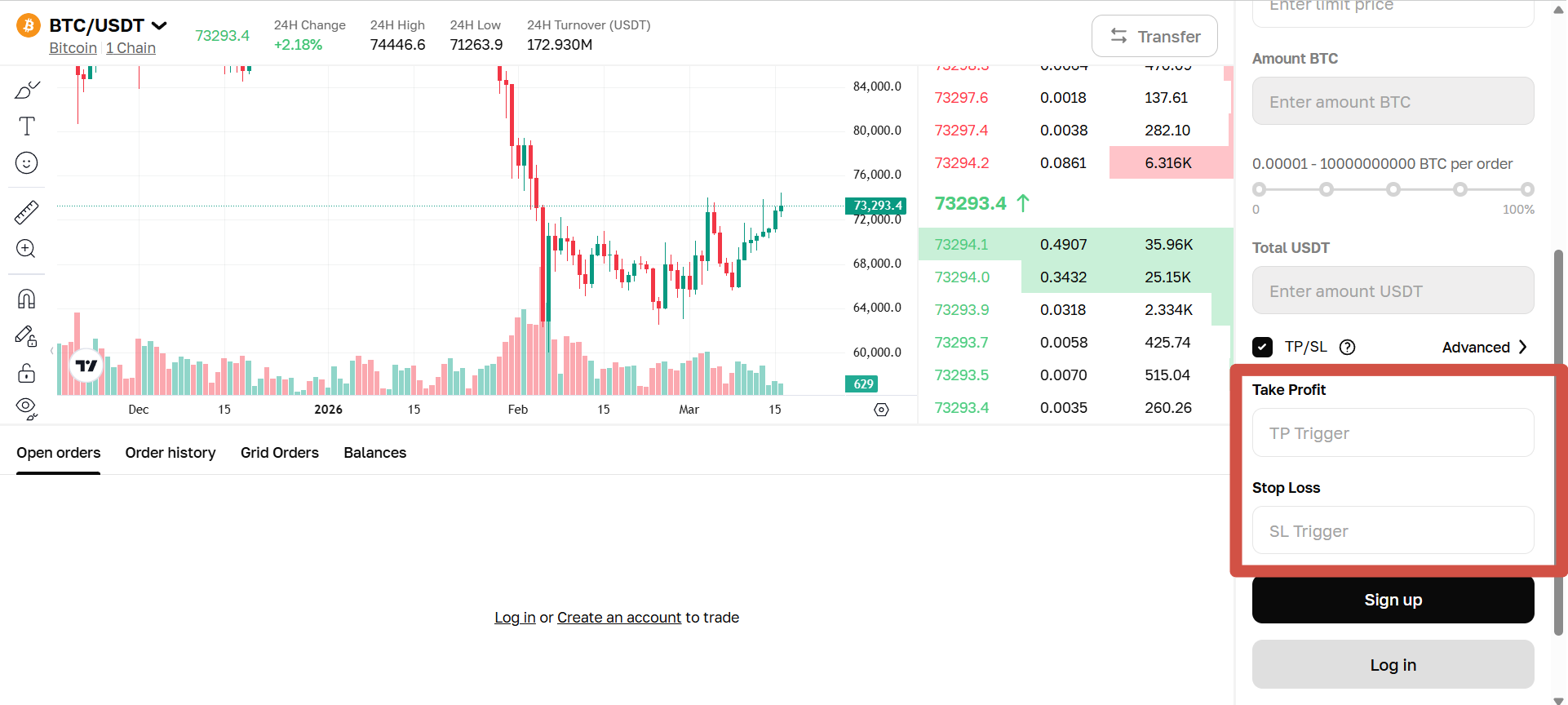
Go to the exchange section, and when purchasing the desired cryptocurrency, check the TP/SL box.
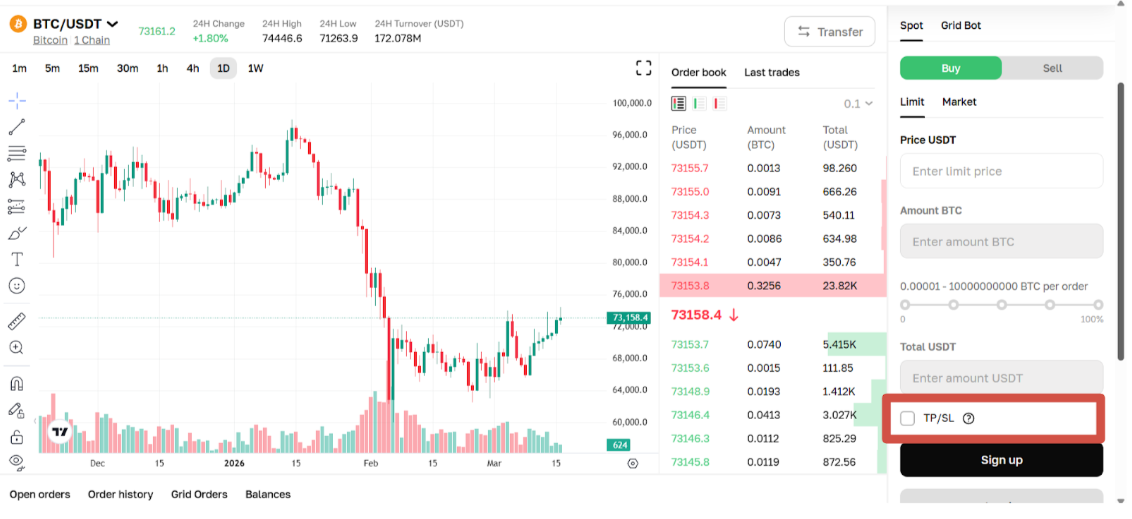
Enter the prices you calculated in advance into the “Take Profit” and “Stop Loss” fields and confirm saving. The system will now automatically monitor the market. If you want to change these levels, you can always click the "Change" or "Edit" button next to your position and enter new numbers.
Common Mistakes to Avoid
Even experienced traders sometimes make mistakes when using these commands. Here are the main pitfalls newbies fall into:
1. Too tight a stop loss. Many set their stop loss very close to the purchase price, hoping to lose next to nothing. But crypto fluctuates constantly. As a result, your stop loss is triggered by a slight market fluctuation, you lose money on commissions and a small loss, and the price skyrockets a minute later without you. To avoid this, use the ATR indicator to calculate volatility: multiply its current value by 1.5 or 2 and set a stop loss at this distance from the entry point.
2. No stop loss at all. This is the most dangerous mistake. Some people think, "I'll just monitor the chart myself”, but the market can plummet 10% in one minute. Without an automatic stop loss, you risk losing everything, especially if you're trading with leverage. Place a protective order simultaneously with opening a trade, perceiving it as mandatory “insurance” for your capital.
3. Moving your stop loss. When the price reaches your stop loss, it becomes scary and frustrating to admit a loss. The trader moves the stop lower, then lower. This is the path to a complete wipeout of the account. The rule here is ironclad: the stop loss can only be moved following a profit, never in the direction of increasing losses.
4. Greed with take profit. Often, people set targets that are too high or cancel their take profit when the price approaches them, hoping to make even more. Ultimately, the price reverses, and a profitable trade turns into a losing one. Use the "ladder" method, taking profits in parts at different levels, and pre-determine exit points before opening a position.
Using stop losses and take profits makes your trading calm and systematic. This transforms you into a responsible money manager. Remember, in the market, it's not the one who guesses the best, but the one who best controls their risks that survives.
 Start trading affordable cryptocurrencies todayAccess low-priced cryptocurrencies, real-time charts, and fast order execution on Cryptomus. Trade trending coins with a user-friendly platform.
We hope this article has helped you understand stop losses and take profits. If you still have questions, feel free to ask them in the comments!


