

David McMillan
Crypto-enthusiast who explores all the possibilities the blockchain technology suggests
What Is A Depth Of Market (DOM)?
Whether you are an experienced trader or just a beginner at the start, you have probably heard about the depth of the order book and its usefulness for crypto strategies. In this article, we will go into detail about what Depth of Market (DOM) is, how it relates to the order book, and what real benefits it can offer to traders — from scalpers to institutional participants.
What Is An Order Book?
To understand what the depth of an order book is, let's first start with the basics. An order book is a digital record of all active buy (bids) and sell (asks) orders for a specific asset, organized by price. It also shows how many tokens traders are looking to buy or sell at each price point.
Simply defined, it is a tool that demonstrates the intentions of market players: who wants to buy or sell a crypto, at what price, and in what quantity. This real-time chart not only captures the participants' intentions but also gives insight into the market’s current state, allowing traders to better comprehend supply and demand to make decisions with confidence.
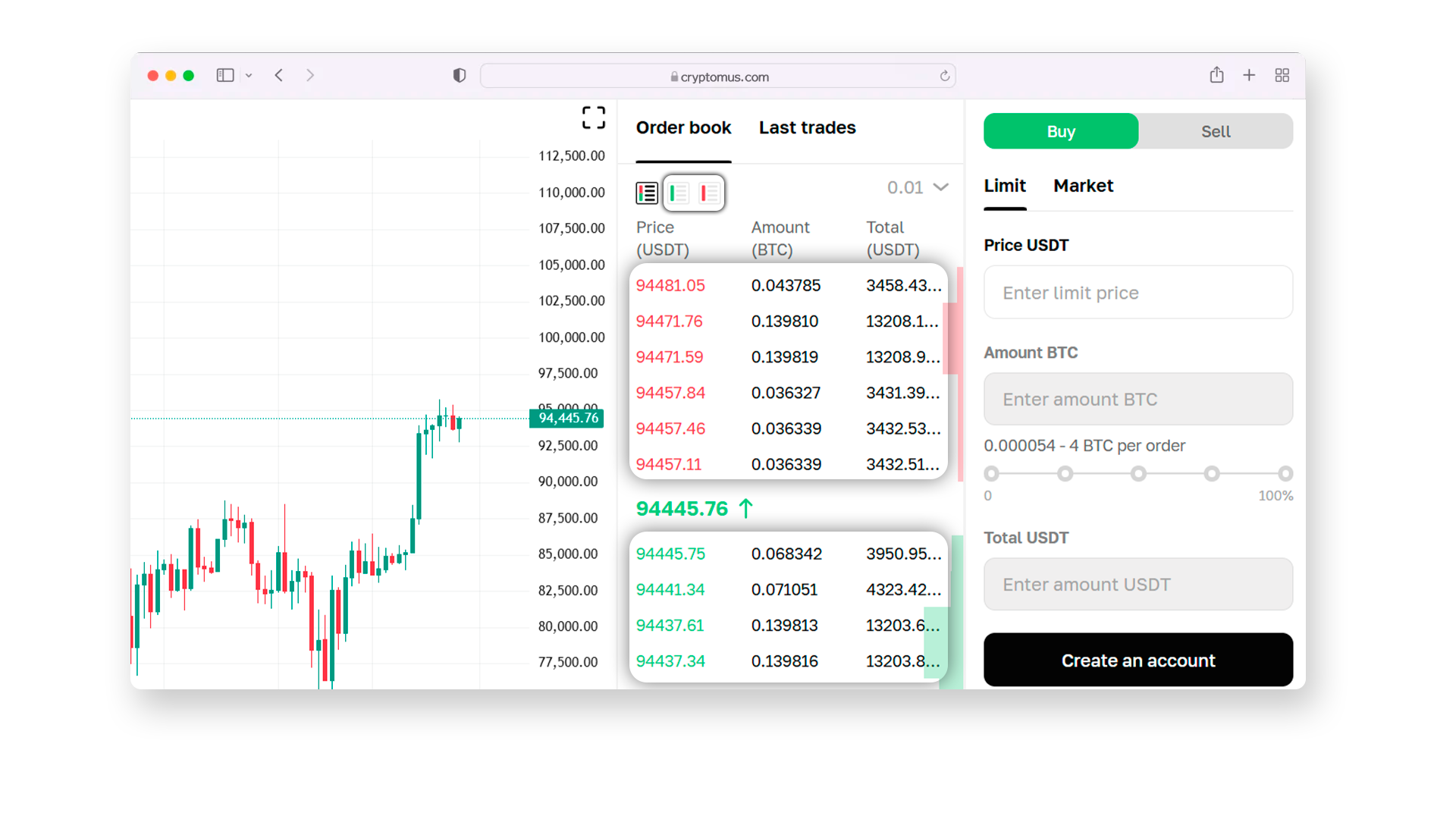
You can find order books on nearly every crypto exchange. For example, in the spot trading mode on Cryptomus, the order book is divided into two sections by color: asks are highlighted in red at the top, and bids are shown in green at the bottom. You can also filter the display to show only buy or sell orders, depending on your preference.
What Is DOM?
Order book depth, also known as Depth of Market (DOM), is a term used in trading to represent the volume of limit orders at a certain price in real time. The more buy and sell limit orders for a particular asset at different price levels, the “deeper” the market is considered to be.
Depth reflects the liquidity of an exchange or market—in other words, how much it can handle relatively large transactions without significant price fluctuations. A deeper market usually signals higher liquidity, where asset prices remain relatively stable even during large trades.
Key Components Of DOM
Market depth is often shown as a chart, which is a visual representation of the order book data. Accordingly, we can identify the main components of DOM: bids, asks, and spread (the difference between supply and demand). Reading depth charts is a valuable skill, as they provide a quick and clear snapshot of market dynamics.
Let's take a closer look at the key components:
-
Bid and asks sides: just like the order book, the depth chart shows bids and asks. Green color usually represents buy orders (bids)—the current market demand. Red color shows sell orders (asks)—the available supply. In the center you can see a line that shows the actual price.
-
The spread: it is the difference between the highest bid and the lowest ask prices; it shows the current average market price.
-
Amount: it is the total quantity of the asset that market participants are willing to buy or sell at a certain price. For example, if ten traders each want to buy two Bitcoin at the same price, the total amount would be 20 BTC.
The depth of the order book is an important part of trading, as it gives you an idea of the market liquidity and potential change in the price of the cryptocurrency. Experienced traders look for familiar patterns on these charts and use them to make educated guesses about where the market might move next.
How Is Depth Of Market Useful For Traders?
Let's talk more about how Depth of Market (DOM) influences trading.
Firstly, understanding the DOM allows you to be much more aware of the current market situation. If bid-side depth increases significantly during a price surge, it may signal growing confidence in the uptrend. On the other hand, if ask-side depth rises during a price decline, it might indicate expectations of further drops.
Secondly, DOM provides insight into market liquidity. When the market is deep, even large orders do not cause significant price movements—the asset is stable. But if the depth is shallow, the slightest movement can cause volatility. This becomes critical for strategies where not only the direction of the price matters, but also the ability to enter or exit positions quickly without slippage.
And finally, it is also worth considering that understanding order book depth can increase the efficiency of trading strategies. For example, spoofing—placing large orders without the intent of executing them—is used to create false signals. Some traders may use markets with shallow depths to manipulate prices with large orders, while such strategies will be less effective in markets with deep order books.

How To Use DOM In Trading?
To help you better understand how to use Depth of Market (DOM) in practice, we have prepared a step-by-step guide:
-
Make sure your platform supports an order book: remember, each book must include bids, asks, and the spread. Some instant cryptocurrency exchanges, such as swap platforms, might not provide order books.
-
Set up your DOM: open the chart window and, depending on your strategy, choose the scale you want.
-
Identify the area of interest: look for price zones with a high concentration of orders.
-
Track order flow in real time: keep in mind DOM is a live stream. Watch how large requests behave: they stay put, increase, or disappear.
-
Enter a trade with liquidity: after you have identified the zone of interest and made sure of the activity of participants, you can prepare to enter.
-
Lock in potential profits: watch the behavior of DOM after entry. If demand continues to rise, price moves up, and you are already in position—your trade is in progress.
-
Close the trade: use DOM to close efficiently. If the market is liquid, a market order may work fine. But if depth is low, it’s better to place a limit order within the nearest liquidity cluster.
Use this guide to minimize potential profit loss and make more confident trading decisions.
 Start spot trading with CryptomusTrade the hottest cryptocurrencies on the best user-friendly platform with convenient features and tools.
To sum up, the depth of the order book is an important indicator for assessing the liquidity and stability of the crypto market. A deep order book provides a more favorable trading environment because it allows traders to make large trades without significantly affecting market prices. No matter your strategy, DOM reveals the inner mechanics of the market—a kind of secondary reality behind every chart. And the sooner you learn to read it, the more confident and accurate your trading decisions will be.
Was this article useful to you? Write about it in the comments and stay with the Cryptomus blog to become more crypto-educated!


